Password-protected correspondence
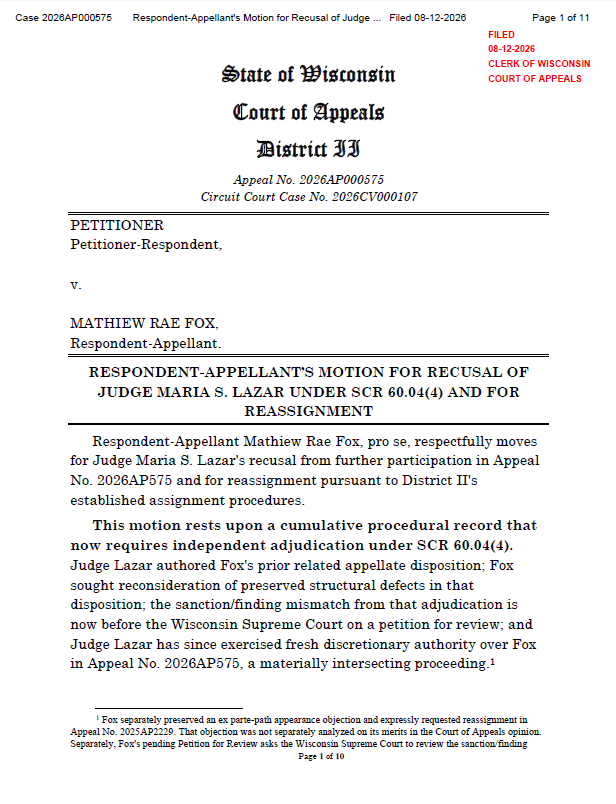
Letter to the Wisconsin Judicial Commission
Request for investigation concerning Judge Maria S. Lazar, dated September 11, 2026. The protected PDF contains 127 pages.

IV-B
Opinions · Wisconsin Court of Appeals, District II
My account of the decisions, procedure, and consequences connected to Judge Maria Lazar and the Wisconsin Court of Appeals, District II.
Password-protected correspondence
Request for investigation concerning Judge Maria S. Lazar, dated September 11, 2026. The protected PDF contains 127 pages.
When I began my journey navigating the appellate system, there was still a lingering hope in my gut that if a circuit court abused its discretion, erroneously exercised that discretion, misapplied the law, or simply got something wrong, the appellate court existed to correct it. That is the simplest way I understood appellate review. A mistake happens below, the record goes upstairs, another judge reads what happened, applies the law correctly, and fixes the error. I firmly believed that once appellate judges actually read the transcripts, orders, briefs, and record, they would understand what had transpired in the circuit court. After living through this process, I no longer carry that same belief. What I have experienced is that the same kinds of errors, the same questionable exercises of discretion, and the same unwillingness to meaningfully confront uncomfortable issues can follow a litigant straight into the appellate court. The names change. The level of the judiciary changes. The robes sit at a different tier. But the human beings inside the system still know one another, work within the same judicial institution, and occupy different ranks within that institution. For an ordinary reader, imagine spending years working in an organization where everyone knows everyone else’s role, reputation, history, and place in the hierarchy. Then imagine being the outsider walking into that structure and asking one level of that organization to declare that another level got something badly wrong. That is the position an appellant occupies.
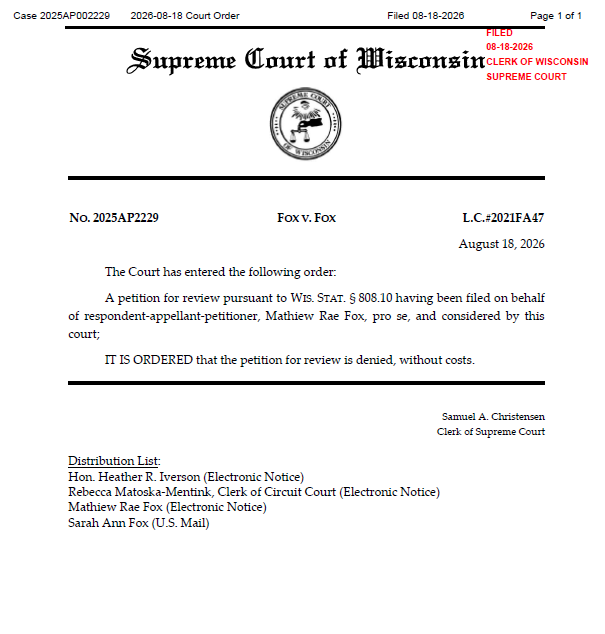
I also came to understand something else very quickly: navigating the Court of Appeals and Wisconsin Supreme Court as a pro se litigant is extraordinarily difficult. Most people never make it that far without an attorney. The financial pressure alone is enormous. There are transcripts to purchase, appellate fees, filing expenses, printing and record costs, and all of it continues while ordinary living expenses and child-support obligations remain. For a father already fighting to maintain a relationship with his children, those costs can become another wall. From my experience, the practical effect of the system is financially crushing. It makes continued litigation progressively harder until many people simply cannot afford to continue. When a father does continue, when he keeps filing, keeps reading the law, keeps identifying contradictions, keeps pointing directly at the record, and refuses to disappear simply because the process has become expensive and exhausting, I believe that persistence itself can become irritating to the institution. Judges have spent years earning their education, building their careers, and acquiring enormous authority. With that authority can come ego and pride. And when a pro se father writes a detailed brief identifying contradictions, legal errors, inconsistencies, and judicial conduct he believes was improper, it means someone without the traditional credentials is telling people with enormous institutional power that they got it wrong. I do not believe every judge responds comfortably to that.
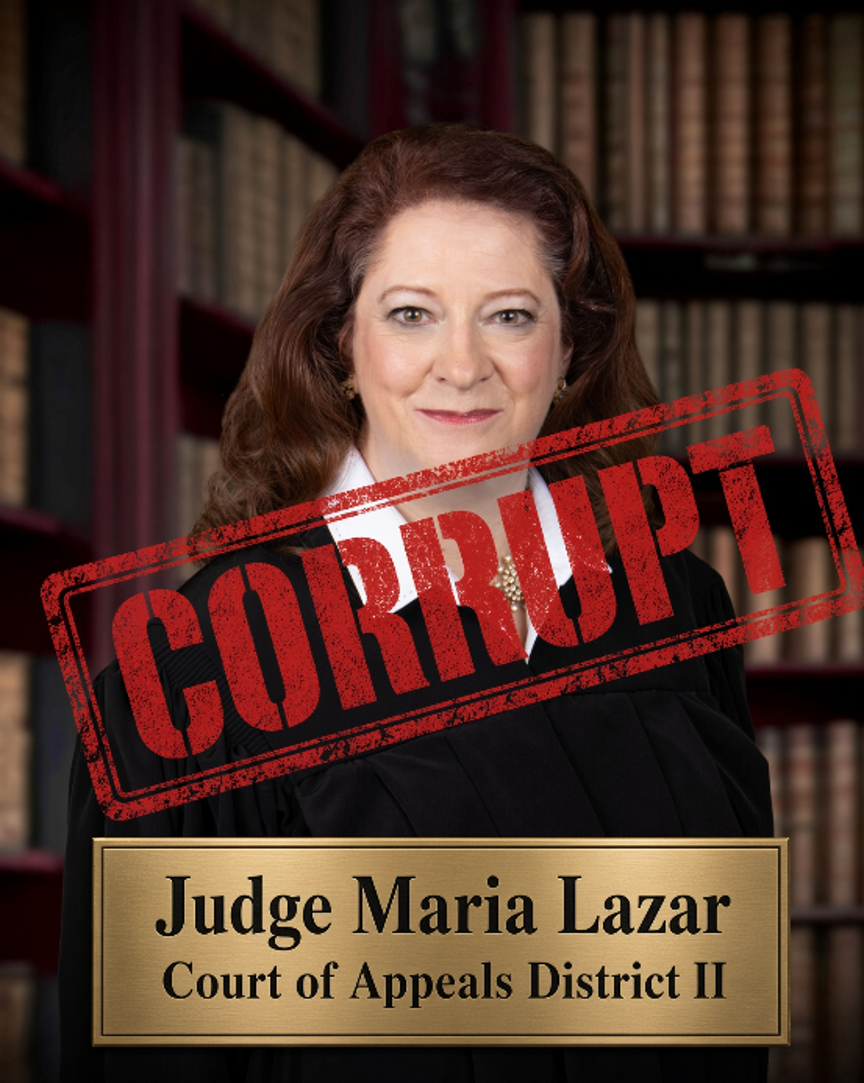
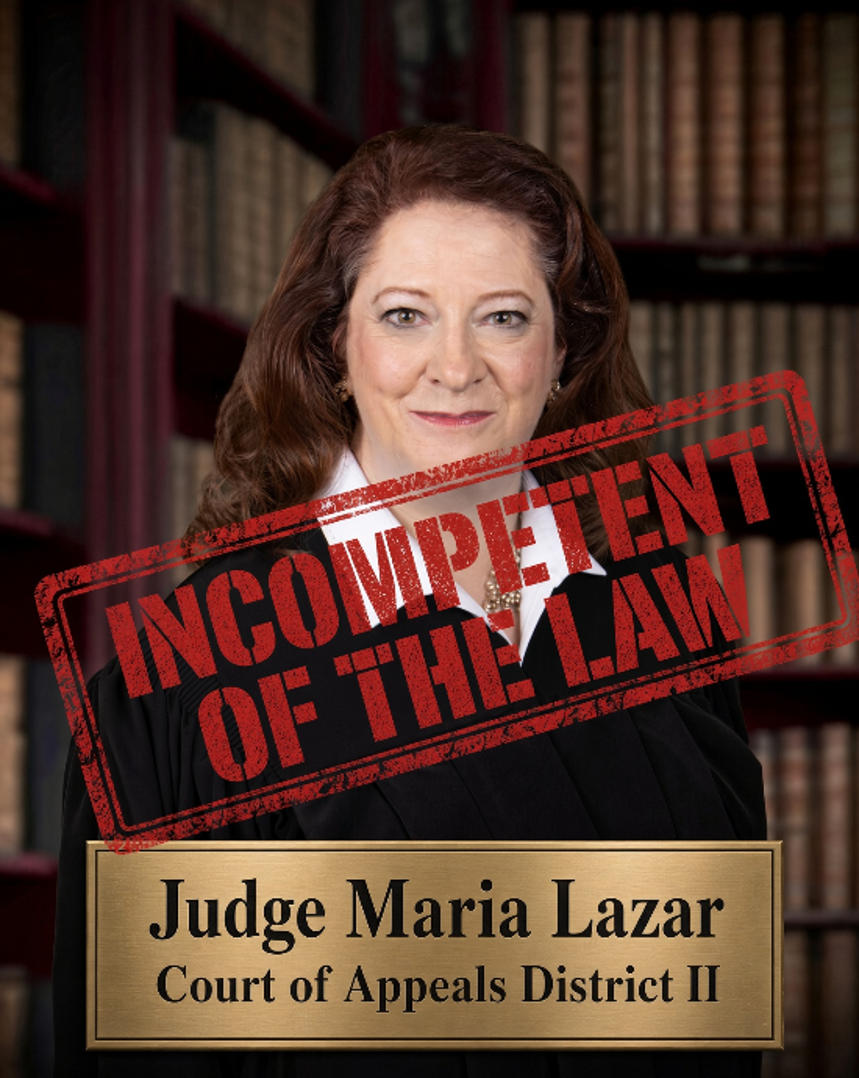
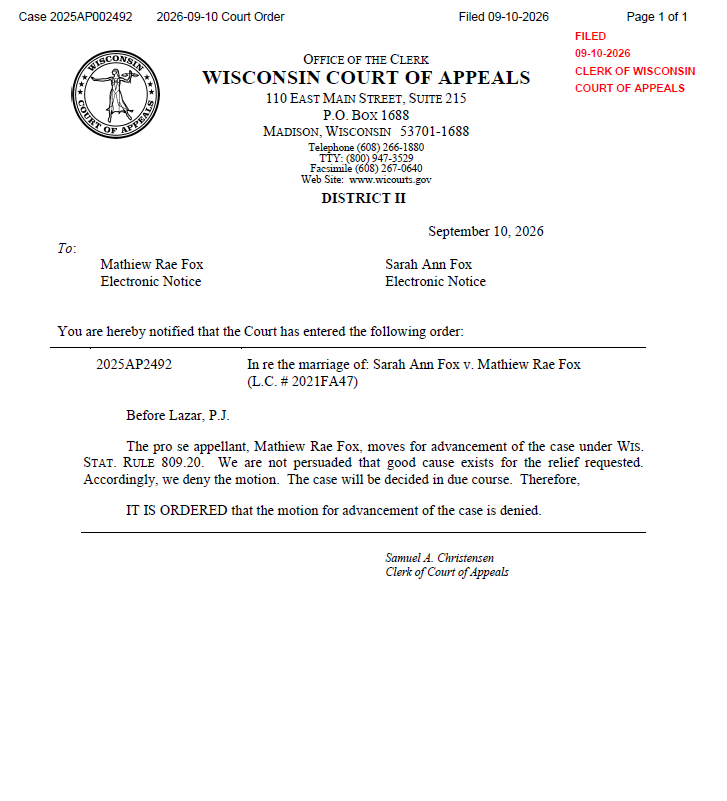
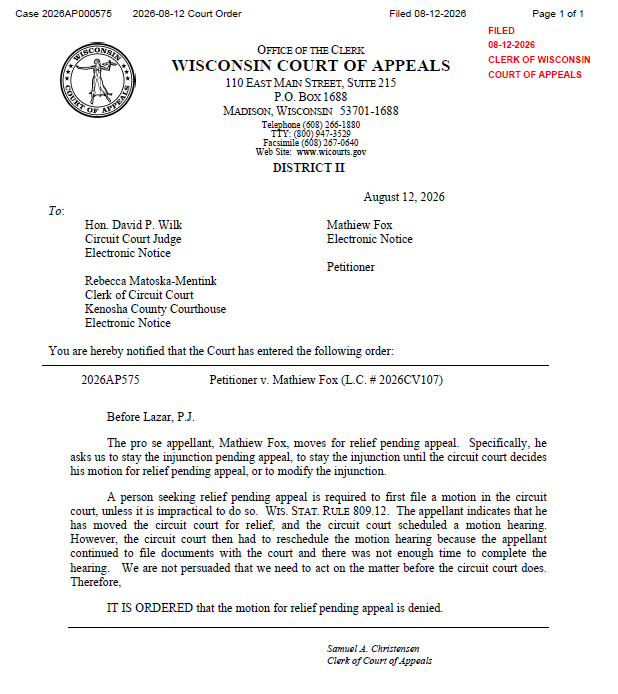
My experience in District II only deepened that concern. Lisa Neubauer had previously presided over matters involving my appellate litigation, and the relief I requested was repeatedly denied. When she retired, Anthony LoCoco became the new presiding judge after running without opposition. I initially believed that transition might bring something different. Based upon what I understood of his background, his emphasis on family, and the public image surrounding his judicial philosophy, I believed the direction of the court might change. I was wrong about what followed in my cases. Maria Lazar became the judge handling significant portions of my appellate litigation, and thus far I have experienced denial after denial, motion after motion, request after request. She even denied my request that she recuse herself, despite having publicly spoken about judicial ethics and recusal principles in other settings. At some point, a litigant begins asking why the answer appears to be “no” regardless of the issue being presented. I began wondering whether the appellate process I had imagined, careful judges independently digging into hundreds of pages of record and testing each issue against the law, was actually what was happening in my case.
That concern became much stronger when I compared my appellate briefing against Maria Lazar’s written opinion. In my view, the opinion does not accurately track several of the central arguments I actually presented. It did not meaningfully confront issues that I believed were squarely developed in the brief. Arguments that I considered critical were narrowed, reframed, passed over, or resolved without engaging the precise contradiction I had identified. My conclusion, after comparing the documents, was that the work reflected sloppy and incomplete reading. Whether that happened because of docket pressure, institutional deference, preconceived conclusions, or something else, I cannot claim to know. But I know what I filed, and I know what the opinion says. Readers do not have to rely upon my characterization. Read my brief. Then read her opinion. Put them beside one another. Ask whether the opinion actually answers the arguments that were made rather than a simplified version of them. The documents are there.
For someone with Maria Lazar’s credentials, and particularly someone who sought a seat on the Wisconsin Supreme Court, I expected an extraordinary level of attention to detail. This was not an abstract commercial dispute involving numbers on a spreadsheet. These proceedings concerned children, a father, a family, and years of childhood that cannot be returned later if a court gets it wrong. A child does not receive those years back because an appellate court eventually recognizes an error. Birthdays disappear. Holidays disappear. School years disappear. Ordinary evenings disappear. Memories that should have existed simply never get created. That is why appellate review in family cases matters so profoundly. Yet from everything I experienced, I came away believing that Maria Lazar did not give those consequences the level of care they deserved. To me, she did not care enough to meaningfully confront what the record showed.
One of the clearest examples involves contempt and the restrictions imposed against me. My position has remained straightforward: the circuit court did not find contempt concerning certain conduct, yet a restriction remained in place that I contend lacked the necessary connection to any valid contempt finding and had no demonstrated relationship to the children’s best interests. Nevertheless, that restriction continued to operate against me. On top of that came restrictions affecting my ability to speak publicly about what was happening in my own case. For me, that raised a constitutional question that could not simply be brushed aside. A father was attempting to speak publicly about his court proceedings, perceived misconduct, and what he believed was happening to his family, while judicial orders were being used to restrict that speech. When a court restricts a litigant’s ability to speak about the conduct of government officials and the operation of a court system, people should ask why. I certainly did. And when the restriction appears alongside allegations of judicial misconduct that the litigant is attempting to expose, I believe the appearance becomes even more troubling. From my perspective, it felt less like protecting children and more like silencing the person challenging what the judiciary had done.
That is where my distrust of the appellate process became something deeper. I began asking myself whether judges working within the same judicial system were truly approaching these disputes as strangers to one another’s work, or whether institutional relationships and familiarity inevitably influence how aggressively one judge is willing to scrutinize another. I cannot prove private communications that I have not seen, and I am not going to pretend otherwise. But when repeated denials occur, when significant arguments appear unanswered, and when the written decision does not appear to track the briefing that was actually submitted, a litigant is entitled to question how independently and thoroughly his case was reviewed. That is my question. I am not asking anybody to accept a conspiracy because I said one exists. I am asking people to read what I filed, read what Maria Lazar wrote, and decide for themselves whether the two actually match.
What makes this particularly painful for me is that I once supported Maria Lazar. I voted for her when she sought a seat on the Wisconsin Supreme Court. I did that because I had read about her work, listened to the public image she presented, and believed she represented the kind of judge who would scrutinize government power rather than protect it. I believed what I saw publicly. After experiencing her judicial work firsthand, I feel profoundly naive for having supported her. There is an additional irony that I now understand very differently: published opinions become part of a judge’s public body of work. They can be studied, criticized, cited, and compared. When a decision is not published, that scrutiny is different. I cannot claim to know why any particular opinion was or was not selected for publication unless the record establishes it. But from where I stand today, I view the distinction with far more skepticism than I once did.
This journey changed the way I look at appellate courts. I began believing they were the safeguard, the place where mistakes made below would finally encounter someone willing to read carefully enough to correct them. I no longer hold that faith automatically. Maria Lazar played a significant role in changing it. She had my briefs. She had the record. She had the opportunity to examine what happened. And I believe she failed to meaningfully address some of the most important errors I placed directly in front of her.
Again, nobody has to take my word for it.
Read the brief.
Read the opinion.
Read the orders.
Then ask whether the arguments were actually answered.
The proof is in the pudding.
And that is perhaps the most painful part of this entire chapter for me. I once cast a vote for Maria Lazar because I believed in the judge she presented herself to be. After becoming a litigant standing on the other side of her authority, I came to see her very differently.
I feel naive for having trusted that image.
I feel stupid for having supported her.
And I will never again confuse a judicial résumé, campaign message, public interview, or polished biography with what a judge actually does when one ordinary father places his children, his constitutional rights, and his faith in the judicial system directly in front of her.