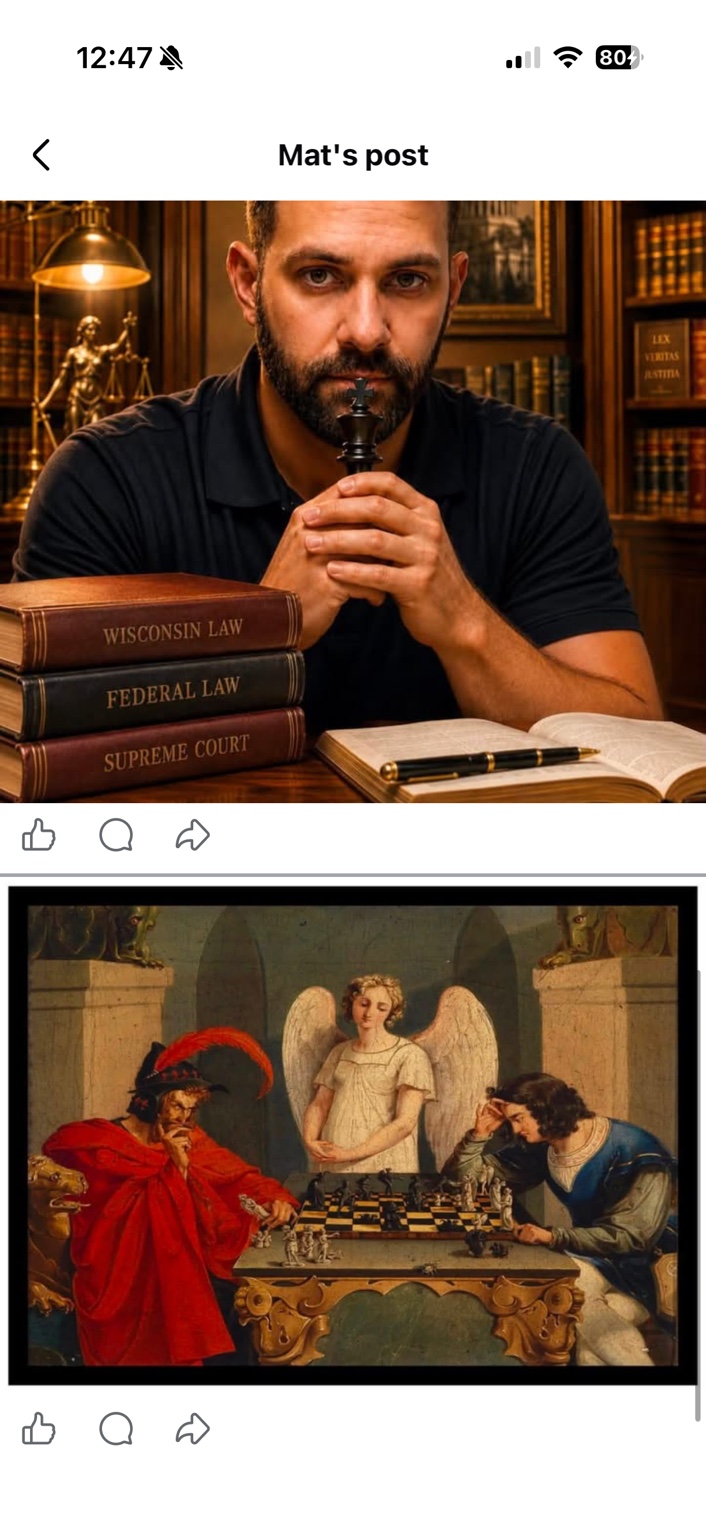
He is looking at an ending. She is looking at the next move.
A man can stare at the board long enough that every fallen piece begins to look like proof that the battle is over. He counts what has been taken, studies every road that has closed, and mistakes exhaustion for defeat. Across from him sits an adversary who needs no final move if despair can persuade the man to surrender first. But behind him stands the angel, silent and unmoved, seeing what anguish has hidden from him. She is not studying what was lost. She is studying what remains. She sees the square he overlooked, the opening buried beneath the wreckage, the possibility that survived every move meant to destroy it. The man believes he has reached checkmate because he cannot see another way forward. The angel knows something different: the inability to see the next move does not mean there is no next move.
And perhaps that is the deepest lesson of the board. There will be moments when life strips away enough pieces that faith itself begins to feel unreasonable, when every calculation says the opponent has too much power and you have too little left. Yet victory is not always found by recovering everything that was lost. Sometimes it begins with protecting the one piece that still matters and refusing to concede the game before the final move has been played. The angel does not overturn the board, erase the past, or move the pieces for him. She simply remains there, looking beyond the man’s despair toward a possibility he cannot yet perceive. He is looking at an ending. She is looking at the next move. And somewhere between those two perspectives lives hope: the quiet realization that being wounded is not the same as being conquered, being surrounded is not the same as being finished, and the King is still standing.
The King is still standing.